
Methodology and limitations
Aitrack records how a Singapore business appears for a defined set of buyer questions across selected AI answer environments. This page explains the evidence trail behind a report, how to read the four core signals, and where the conclusions stop.
Every usable observation connects one buyer question with one AI source in a specific run. That pairing matters. A business can appear for one intent and be absent for another, and a source that did not return usable evidence is not treated as a negative answer.
The public method can be understood in four stages. Each stage narrows what the final report is allowed to claim.
Set the scope
Business context, industry details, relevant tags and area define what the run is about.
Organise buyer questions
Questions reflect neutral customer intent and are not written to force the target business into an answer.
Observe selected sources
Only sources selected or applied by default and able to return usable evidence contribute observations.
Classify returned evidence
The report separates mentions, recommendations, citations, competitor appearances and source availability before summarising the run.
The signals are related, but they are not interchangeable. Read each one as a specific statement about the answer that was observed.
This view keeps every answer tied to the question and source that produced it. It also separates a business miss from a source that was not run, so incomplete coverage is not reported as poor performance.
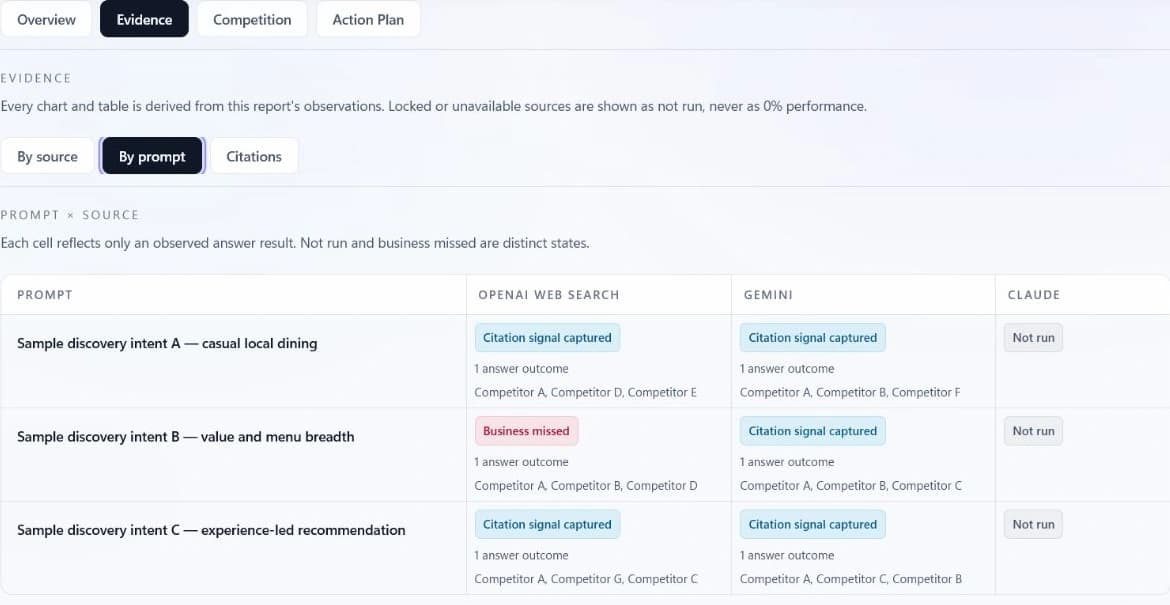
Illustrative product view using sample data. The layout explains evidence states; the values are not customer results.
Buyer question
Each row keeps the original customer intent visible.
Observed state
Each cell records what returned for that question and source.
Coverage boundary
Not run remains distinct from an observed business miss.
Start with what ran and what returned usable evidence. Then inspect answer-level mentions, citations and competitors. A summary score can help with navigation, but the supporting evidence tells you what the report actually observed.
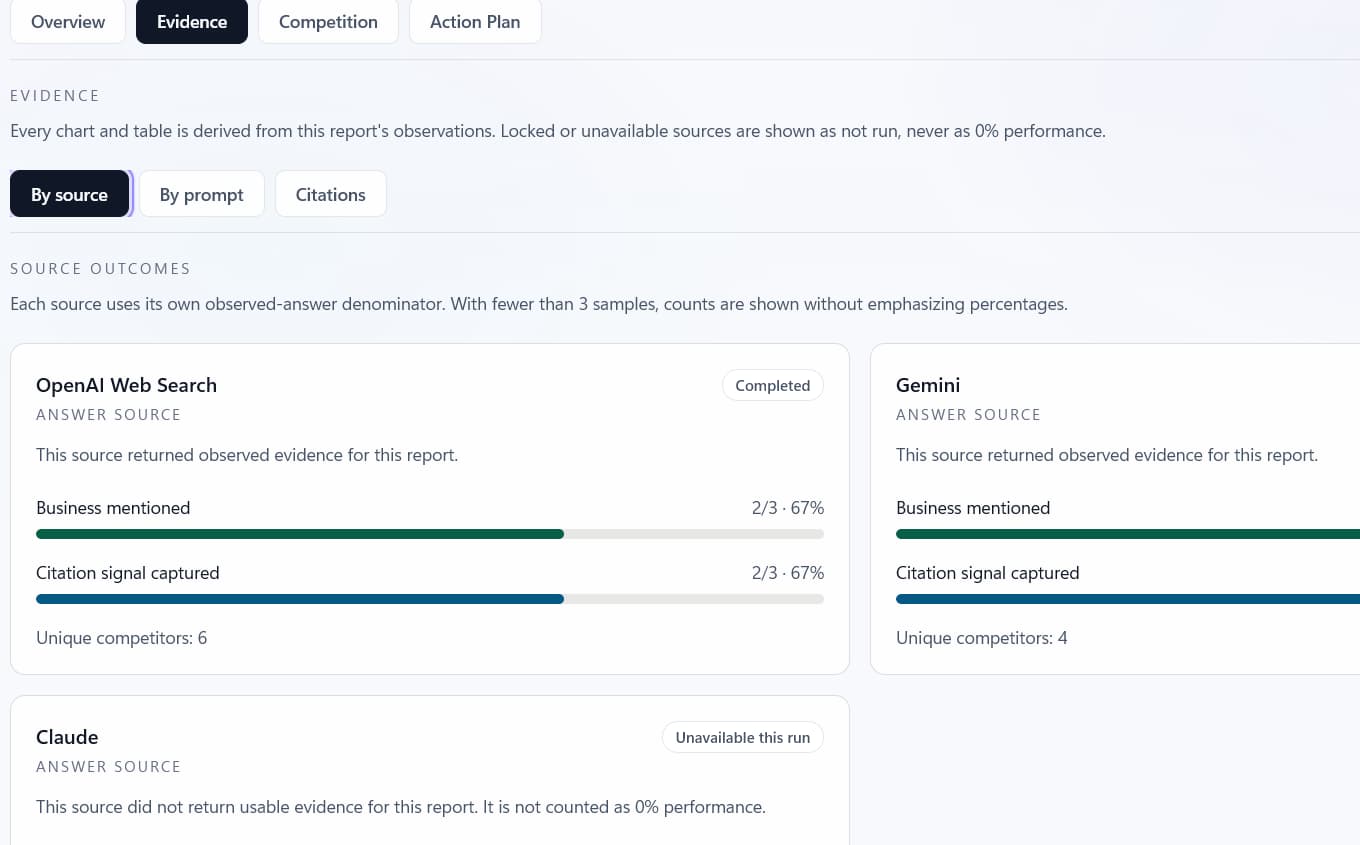
Illustrative product view using sample data. Source availability belongs to the interpretation of every report.
Completed
Usable observations were returned for this run.
Answer signals
Mentions and citation signals are shown against that source's observed answers.
Unavailable
No performance conclusion is drawn from a source without usable evidence.
Aitrack currently offers eight selectable AI sources: ChatGPT, Google AI Overviews, Gemini, Claude, Grok, Perplexity, Doubao and DeepSeek. That product range is wider than the coverage of any single report.
Treat the report as an evidence-led decision aid. Start with coverage and the returned answers, then use the summary to decide what deserves verification or improvement.
Confirm coverage
Check which sources returned usable evidence and which did not.
Inspect the answers
Read the question-by-source evidence, cited pages and competitor appearances.
Separate the gaps
Distinguish missing public facts, weak supporting evidence and competitor pressure before deciding what to change.
Compare like with like
Repeat under similar conditions if you want to understand whether the observed pattern changed.