
A business owner does not need another dashboard that turns uncertainty into a mysterious score. They need to know what customers may see when they ask an AI platform for help, which evidence supports that answer, and what to improve next. This guide opens the Aitrack.sg workflow so teams researching AI visibility in Singapore can understand the scan before relying on it.
Aitrack separates a brand mention from a recommendation, citation, and competitor appearance instead of treating every result as the same win.
Each observation belongs to a specific customer question, AI source, and point in time; it is evidence from a run, not a permanent ranking.
AI visibility explains the answer layer. Traffic, conversions, and revenue still require analytics data alongside the scan.
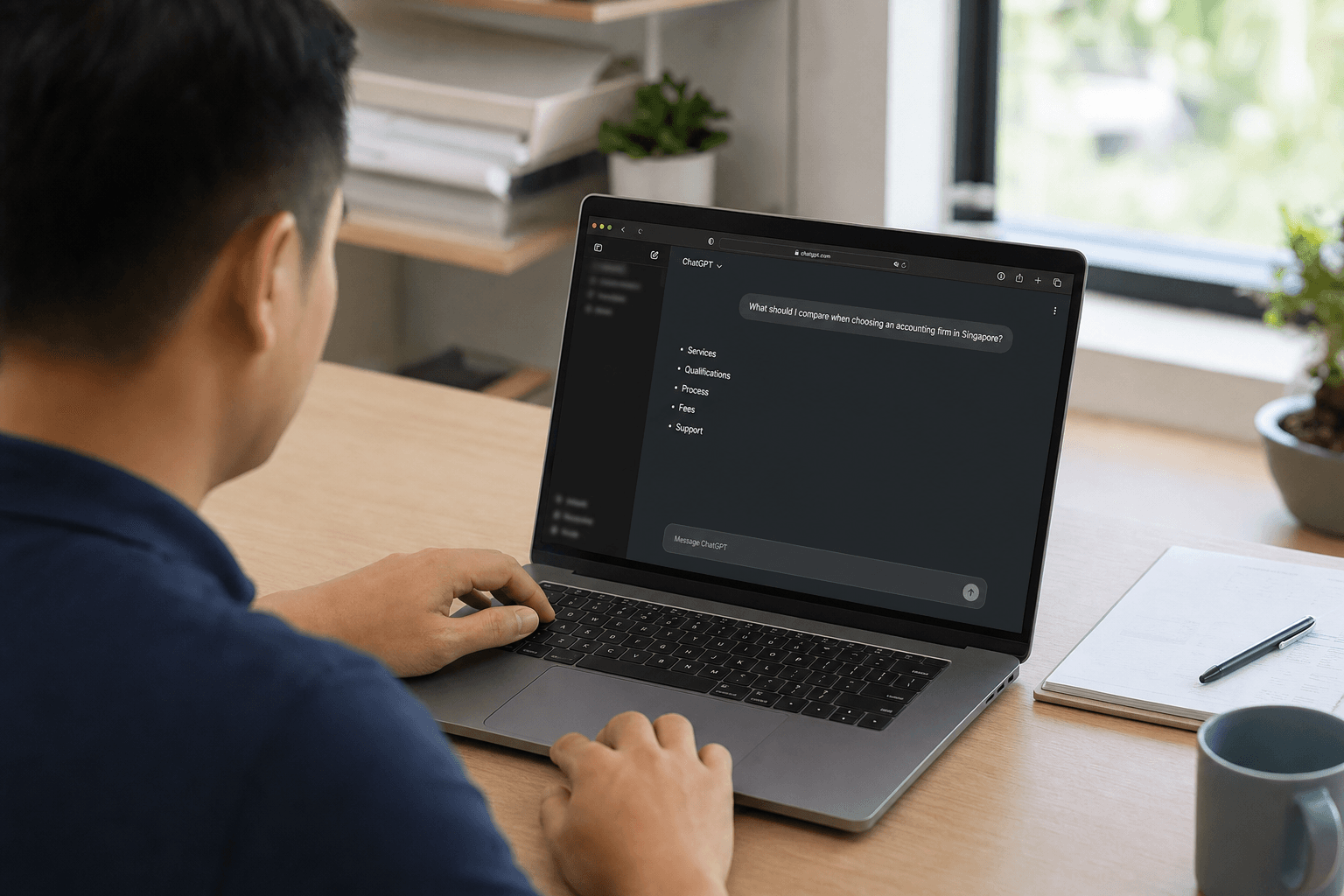
The useful starting point is a question a potential customer might ask before choosing a provider. A Singapore founder may ask what to compare when selecting an accounting firm. A homeowner may ask how to shortlist renovation companies for an HDB flat. A parent may ask which tuition options fit a particular level, subject, or location.
These questions carry more commercial context than typing a business name alone. A branded question can show whether an AI system recognises the entity, but not whether the business enters the answer before the customer has chosen a provider.
Aitrack starts from real-user prompts connected to the business and its market. A Quick Scan checks three prompts across the selected AI sources and returns a preview of visibility, competitors, and major gaps. The result is more useful when the questions represent different decisions instead of repeating the same keyword in slightly different words.
An AI answer is not a binary result. A business may be named without being suggested. It may be recommended while the supporting citation points to a directory. It may be absent while two direct competitors appear. Aitrack keeps these signals separate so the report can explain what happened rather than simply mark the run as visible or invisible.
The distinction matters for AI search results in Singapore because each signal suggests a different next step. A mention can show recognition. Recommendation context is closer to commercial consideration. A citation reveals which source helped support the answer. Competitor presence shows who else received answer space for the same customer question.

| Signal | What the scan records | Why it matters |
|---|---|---|
| Mention | The business is named in the answer. | Recognition exists, but the context may still be neutral or incidental. |
| Recommendation | The business is presented as a relevant option. | The answer places the brand closer to a real customer decision. |
| Citation | A source or URL is used to support the answer. | The source shows where the platform found evidence and whether owned pages are contributing. |
| Competitor | Another provider appears for the same prompt. | The result reveals which alternatives are taking answer space and in what context. |
Every observation needs context. The wording of the question changes the task. Best, nearby, suitable for startups, open late, and experienced with commercial projects are different qualifiers. A business can be relevant to one version and unsuitable for another. Removing those details to produce a better-looking score would make the result less useful.
The AI source matters too. ChatGPT, Gemini, Perplexity, Claude, Google AI answers, and other systems may use different retrieval methods, source coverage, or answer formats. Aitrack records source-level observations rather than implying that one response represents every platform.
The date completes the evidence. Generated answers can change after a model update, a source change, new public information, or ordinary response variation. A scan is therefore a dated snapshot. Repeating a stable prompt set after a meaningful website or citation improvement can reveal a pattern; rerunning until a preferred answer appears cannot.
Aitrack checks what appears in the answer layer. It does not claim that every mention produced a website visit, enquiry, booking, or sale. Some AI experiences provide citations and links, while others may influence a decision before the customer clicks anything. Visibility evidence and traffic evidence answer related but different questions.
If your goal is auditing AI search traffic, use web analytics, Search Console, conversion tracking, and enquiry records alongside the scan. Aitrack adds different context: which prompts exposed the brand, which sources cited it, and which competitors appeared.
The same boundary applies to AI search optimisation in Singapore. Improving a service page or citation source may make the public evidence clearer, but no responsible tool can guarantee a platform will recommend the business. The practical goal is to publish accurate evidence, observe the result, and improve the weakest verified gap.
The value of a scan appears after the answer is collected. If the business is not recognised, first check entity clarity: name, website, location, category, and consistent public profiles. If it is mentioned but not recommended, review whether service fit, audience, process, and proof are explicit enough for the customer question.
If a third-party page is cited instead of the official website, compare the useful facts on both sources. The owned page may need clearer explanations, original evidence, named expertise, maintained policies, or a direct answer. If competitors dominate, study what made them relevant without copying unsupported claims.
Aitrack connects prompt evidence, source observations, citations, competitors, and priority actions so a team can choose the next page or proof signal to improve. The workflow should end with a change the business owns, followed by a later check using the same question.

Aitrack.sg provides three free scans as a low-friction starting point. Use them to test a real business, see whether the basic problem exists, and learn which question deserves deeper review. A free result is a snapshot, not a complete strategy.
A Full Audit adds prompt-level evidence, citations, competitors, and prioritised actions across selected AI sources. A Health Check reviews the owned foundation, including entity clarity, public discoverability, website support, citation readiness, schema, and trust signals. Monitoring compares a stable prompt set after meaningful changes.
The right next step is not always the largest report. Start with the decision you need to make, inspect the evidence available in the current run, and choose more depth only when it will change an action. That is the purpose of an AI visibility scan: make an unfamiliar discovery layer concrete enough to work on.
Restaurant Discovery
A customer-journey guide to the public restaurant details that help AI search understand a dining option without treating a snapshot as a guaranteed recommendation.
AI Search Readiness
A practical guide for Singapore businesses that want FAQ pages to answer real buying questions instead of becoming a collection of generic search copy.
AI Search Readiness
A practical, page-by-page review for Singapore service businesses that want customers and AI answer systems to understand what they actually provide.