
AI visibility is often discussed as if every business competes in one global answer space. A Singapore business operates in a much tighter context: neighbourhoods, branches, local service terms, sector-specific proof, and sources that customers recognise here. Measuring that context reveals more than checking whether an AI platform knows the brand name.

Singapore AI visibility should be measured across brand, category, location, service, trust, and comparison questions.
Clear branch identity, local service language, and consistent public evidence help AI systems distinguish the right business and situation.
The useful outcome is a local evidence map and repeatable benchmark, not a single universal visibility score.
A branded prompt such as tell me about this company tests recognition. It does not show whether the business appears when a customer has not chosen a brand. Commercial discovery usually begins with a need: an accountant for a new company, a tuition centre for a particular level, a renovation firm for an HDB resale flat, or a cafe suitable for a weekday meeting.
A useful Singapore AI visibility check therefore starts with the market the business wants to enter. What category does it belong to? Which services matter? Which customers and locations does it serve? What evidence should justify a recommendation? The answers become a prompt set that tests discovery rather than simple name recall.
Singapore is compact, but customer intent can still be highly specific. A query may include a neighbourhood, MRT area, property type, age group, business stage, opening time, language preference, or service format. Two prompts in the same category can produce different shortlists because the practical requirement is different.
For example, a broad search for a tuition centre in Singapore is not equivalent to a search for Primary Maths lessons near Bishan. A renovation query for a condominium is not identical to one for an HDB resale flat. A corporate-services query for incorporation support is different from ongoing bookkeeping or payroll administration.
Do not manufacture dozens of tiny prompt variations. Choose the local qualifiers that change eligibility, suitability, distance, or trust. Record them as distinct intent groups so a strong branded result cannot hide weak category or location visibility.
A business name alone may not identify the correct entity. Singapore companies can have a legal name, a trading name, several outlets, old directory profiles, related brands, or similar names in another market. The website should make the relationship between brand, company, branch, location, contact details, and services easy to verify.
For a multi-location business, each branch needs a stable public identity. Show the address, contact method, operating details, services available there, and how the branch relates to the main brand. If a service is offered islandwide, state what that means instead of leaving AI systems to infer coverage from one office address.
Consistency matters beyond the website. Reputable listings, professional profiles, social pages, and local references should not contradict the current business information. An outdated branch or different phone number can weaken an otherwise clear page.
AI systems may encounter a business through its own pages and through independent public sources. The exact source mix can differ by platform and answer, so the goal is not to chase one directory. Build a coherent evidence network: accurate service and location pages, real team information, useful policies, verifiable credentials, reputable coverage, and consistent listings.
Singapore businesses should use authoritative sources where the subject requires them. An accounting article may link to relevant guidance from IRAS or ACRA. A regulated or healthcare-adjacent service should describe qualifications and limitations accurately. A renovation firm should avoid implying approvals or registrations it does not hold. The source should support the claim rather than merely decorate the page.
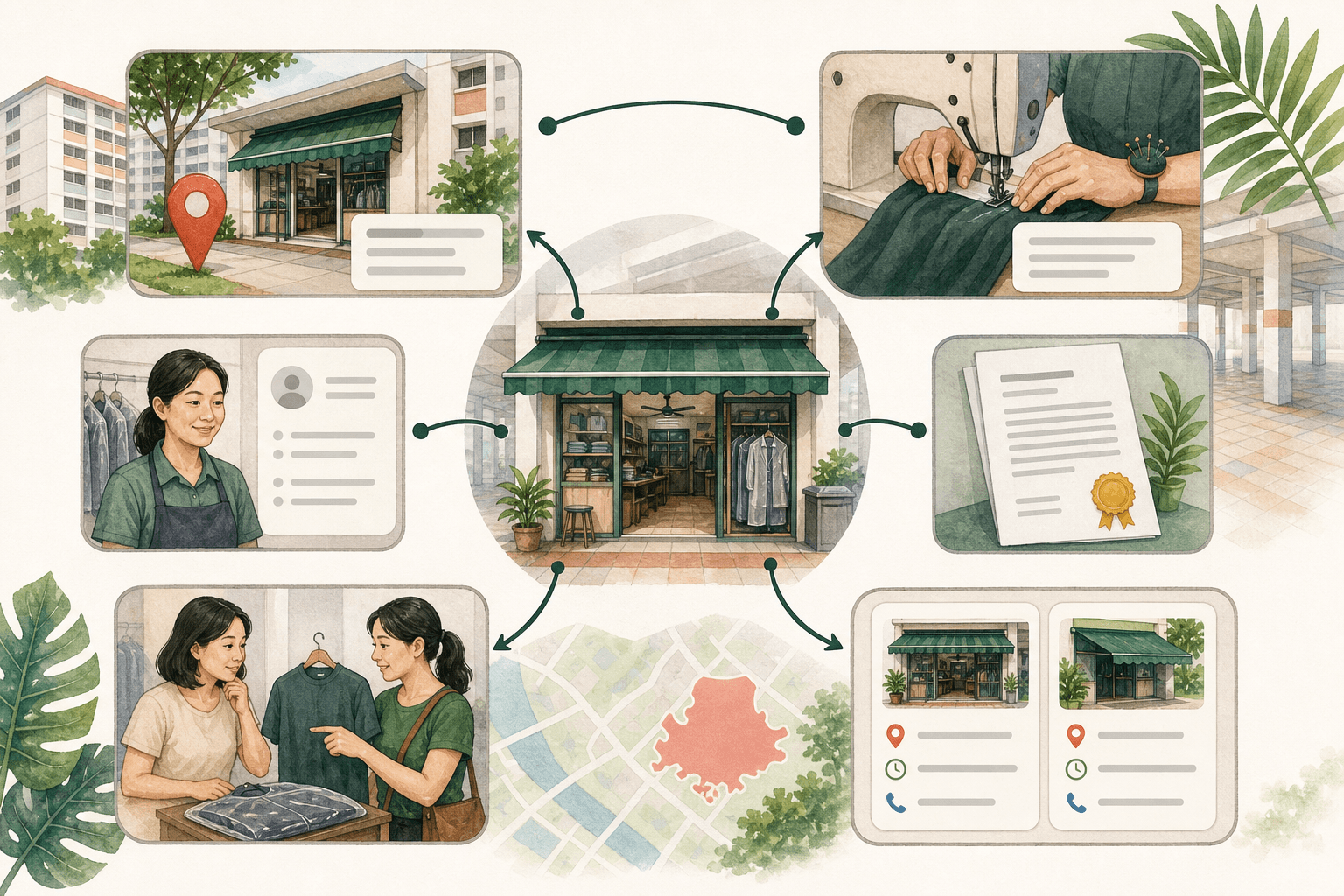
The illustration shows how location, service delivery, people, independent documents, customer comparison, and consistent listings connect around one local business. No single signal replaces the rest.
A global checklist may say add trust signals, but the useful proof depends on the decision. A cafe needs accurate location, hours, menu context, dietary information where applicable, and a clear reason it suits the occasion. A tuition centre needs programme scope, level, branch, teacher information, learning format, and responsible evidence about how it operates.
A renovation firm needs project context, property type, scope, process, team, and verifiable credentials. An accounting firm needs precise service boundaries, professional information, current educational sources, and a clear distinction between general content and advice for a specific business. A clinic or wellness provider must be especially careful not to turn marketing claims into unsupported health outcomes.
A local benchmark should use a stable group of prompts and record more than whether the brand appears. Note the business mentioned, recommendation context, factual accuracy, cited sources, competitors, and any local qualifier the answer understood or missed. Compare patterns across platforms and dates rather than treating one answer as a permanent ranking.
The framework below is a practical starting point. Adapt the examples to the real category and avoid testing locations or services the business does not actually cover.
| Prompt family | Singapore example | What to record |
|---|---|---|
| Brand | What does this local business provide? | Entity accuracy, branches, services, cited source |
| Category | Which providers suit this need in Singapore? | Mentions, recommendation reasons, competitors |
| Location | Options near a relevant neighbourhood or MRT area | Branch match, distance context, outdated listings |
| Service | Providers for a specific service or situation | Service fit, exclusions, supporting page |
| Trust | How should a customer compare credible options? | Credentials, policies, proof, source quality |
| Comparison | How do two relevant options differ? | Accuracy, strengths cited, missing evidence |
Restaurant Discovery
A customer-journey guide to the public restaurant details that help AI search understand a dining option without treating a snapshot as a guaranteed recommendation.
Product Guide
A transparent look at the evidence inside an Aitrack.sg scan, the questions it can answer, and where traffic or conversion analytics still belong.
AI Search Readiness
A practical guide for Singapore businesses that want FAQ pages to answer real buying questions instead of becoming a collection of generic search copy.