
Tools
Full Audit turns prompt-level AI observations into a deeper report with evidence, competitors, citations, and prioritized actions.
The overview gives the result a clear starting point: a time-stamped visibility score, evidence interpretation, completed sources, weighted signals, and a compact competitor snapshot.
The headline stays connected to raw counts and denominators so the user can see the scale of the evidence rather than treating one percentage as a permanent ranking.
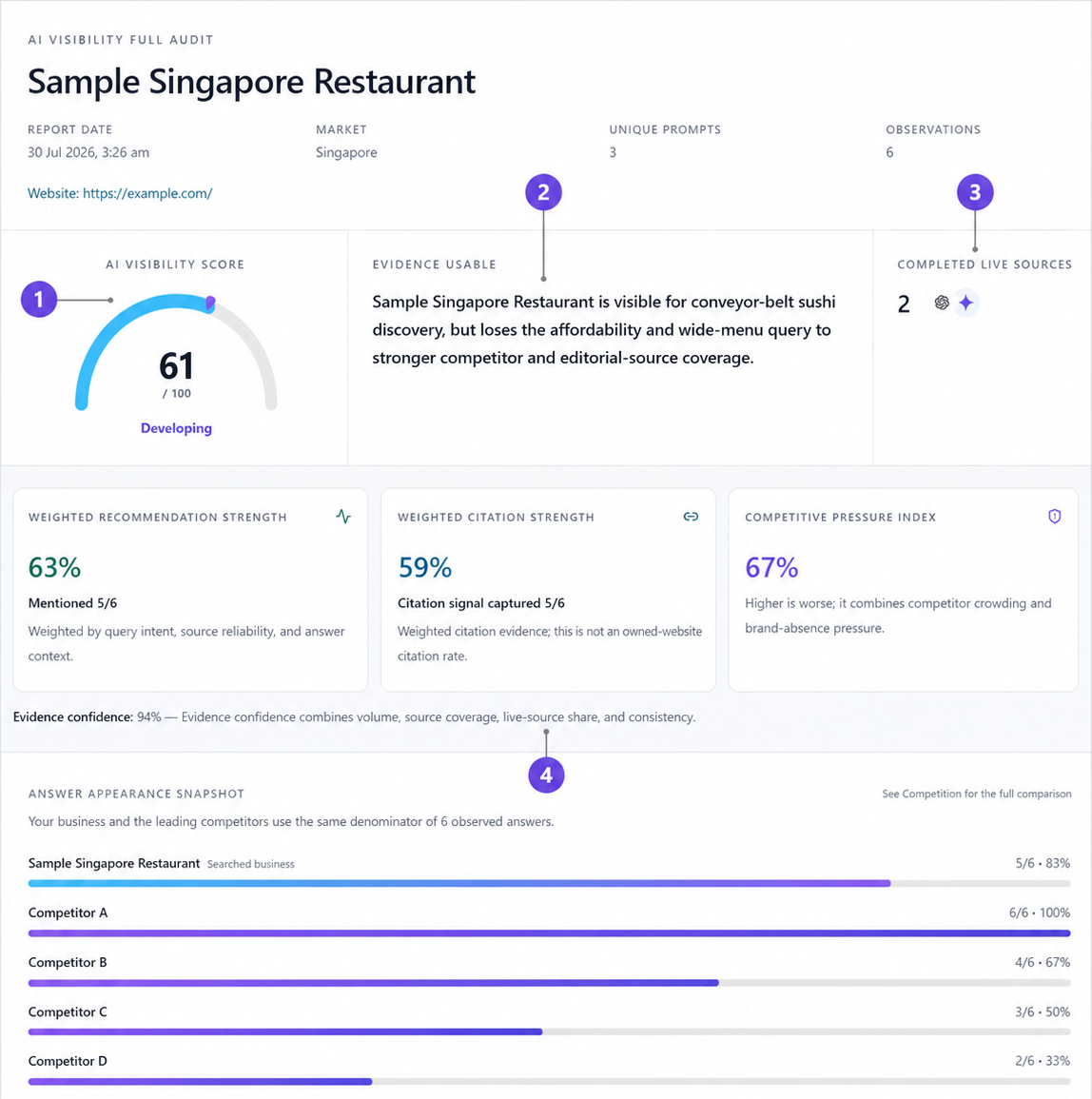
A completed, anonymized Full Audit overview. Business and competitor identities have been removed while the real product structure and data relationships remain visible.
View full-size imageOverall visibility snapshot
A time-stamped score summarizes recommendation and citation evidence across the observed answers.
Evidence-backed interpretation
The report explains what the score means and identifies the most important visibility gap.
Completed AI sources
Coverage shows which selected platforms returned usable evidence in this run.
Confidence and comparison context
Weighted signals retain raw counts, denominators, and competitor appearance beside the headline score.
Each selected AI source is evaluated only on the answers it actually returned in the current run. Mention and citation counts therefore keep their own source-specific denominator.
An unavailable source is shown as not run rather than being converted into 0% performance. This keeps temporary source limitations separate from a genuine business miss.
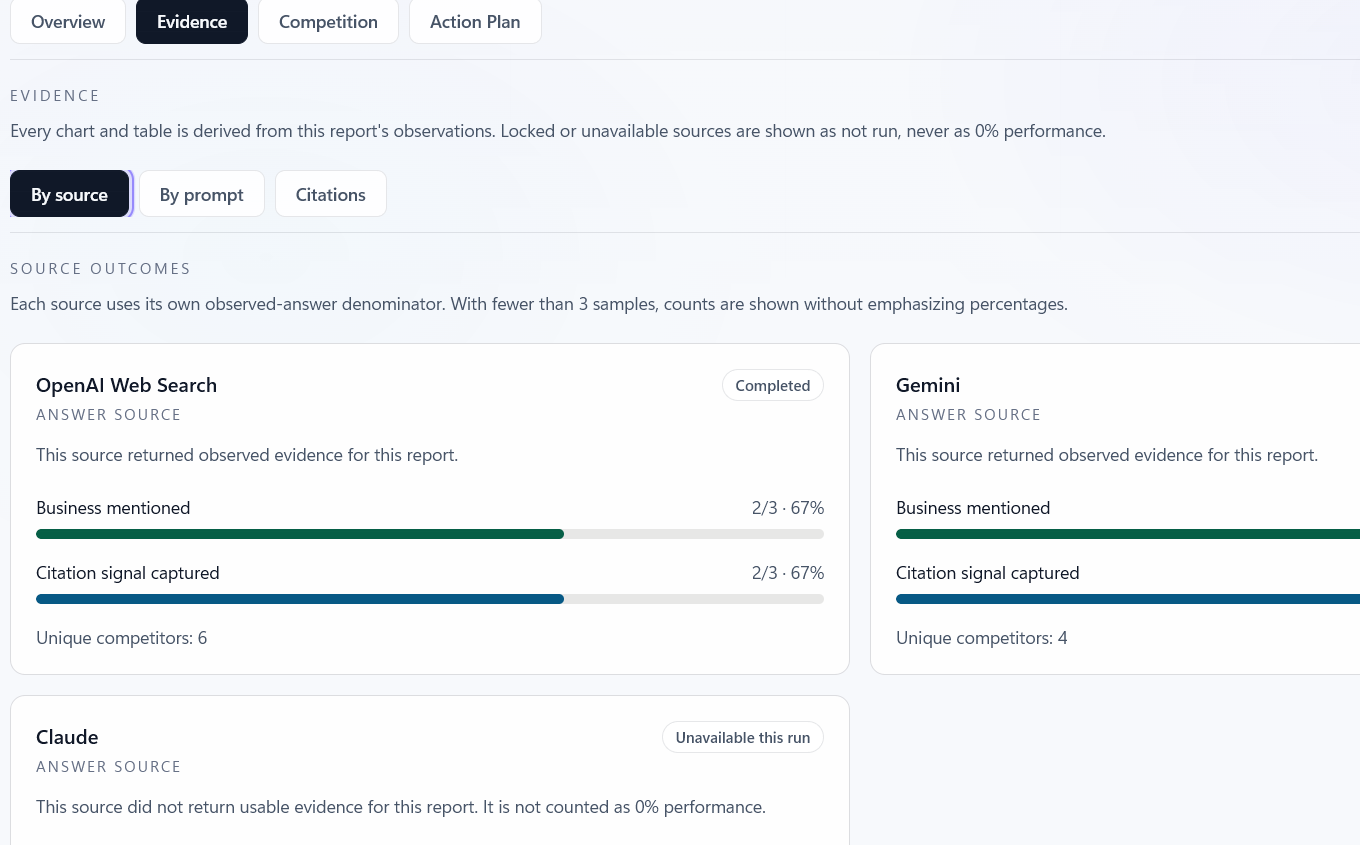
The by-source view makes platform differences visible. The screenshot comes from a real report with the business identity removed.
View full-size imageEvidence separated by platform
Each source shows business mentions, citation signals, and the number of competitors it returned.
Returned answers set the denominator
Rates use only the answers actually observed for that source in the current run.
Unavailable is not 0%
A source with no usable return stays Not run and does not lower business performance.
The prompt-by-source view shows where a citation signal was captured, where the business was missed, and where a source did not run. The three states are intentionally distinct.
In this public walkthrough, the exact prompts are replaced by high-level discovery intent labels. The real product retains the observed prompt context without exposing the private prompt set in the Knowledge Base.
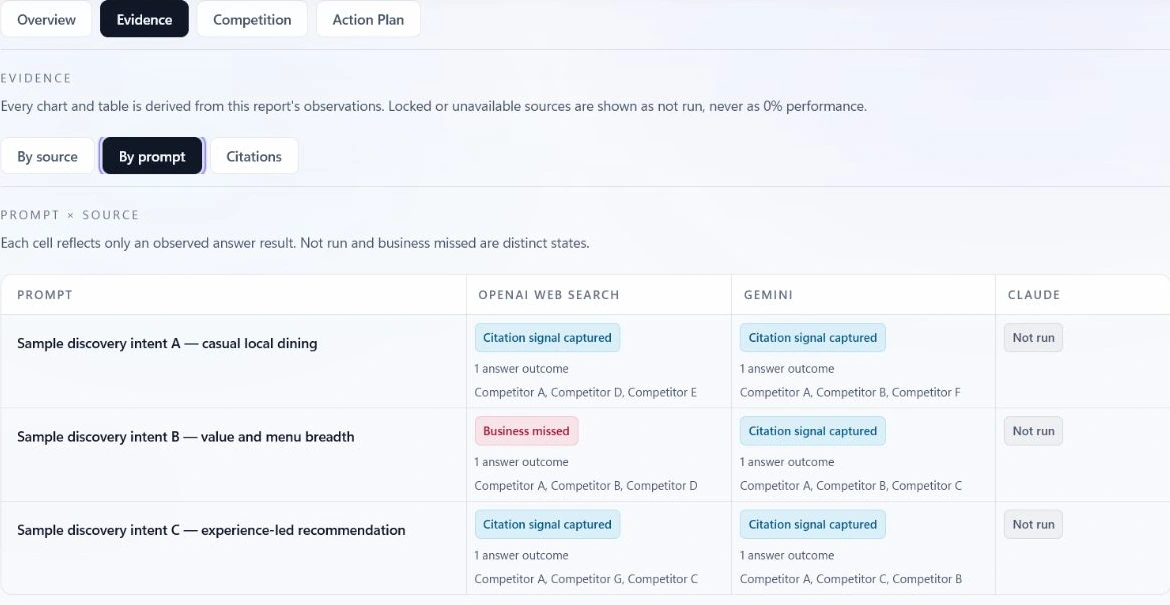
The prompt-by-source matrix preserves the report states while removing exact test wording and business identities.
View full-size imagePublic example protects prompt detail
Exact prompts are replaced by discovery intent labels rather than exposing the private prompt set.
Business missed is an observed result
It means the business was absent from an answer that actually returned, not that the source failed.
Not run is a source state
A source without usable evidence remains distinct from a completed answer that missed the business.
A citation signal does not automatically mean the business's own website was cited. Full Audit classifies cited URLs as owned, competitor, third-party, or unknown so users can see who currently supplies the evidence.
The anonymized table preserves the ownership mix, source counts, and prompt counts while replacing real domains with neutral examples.
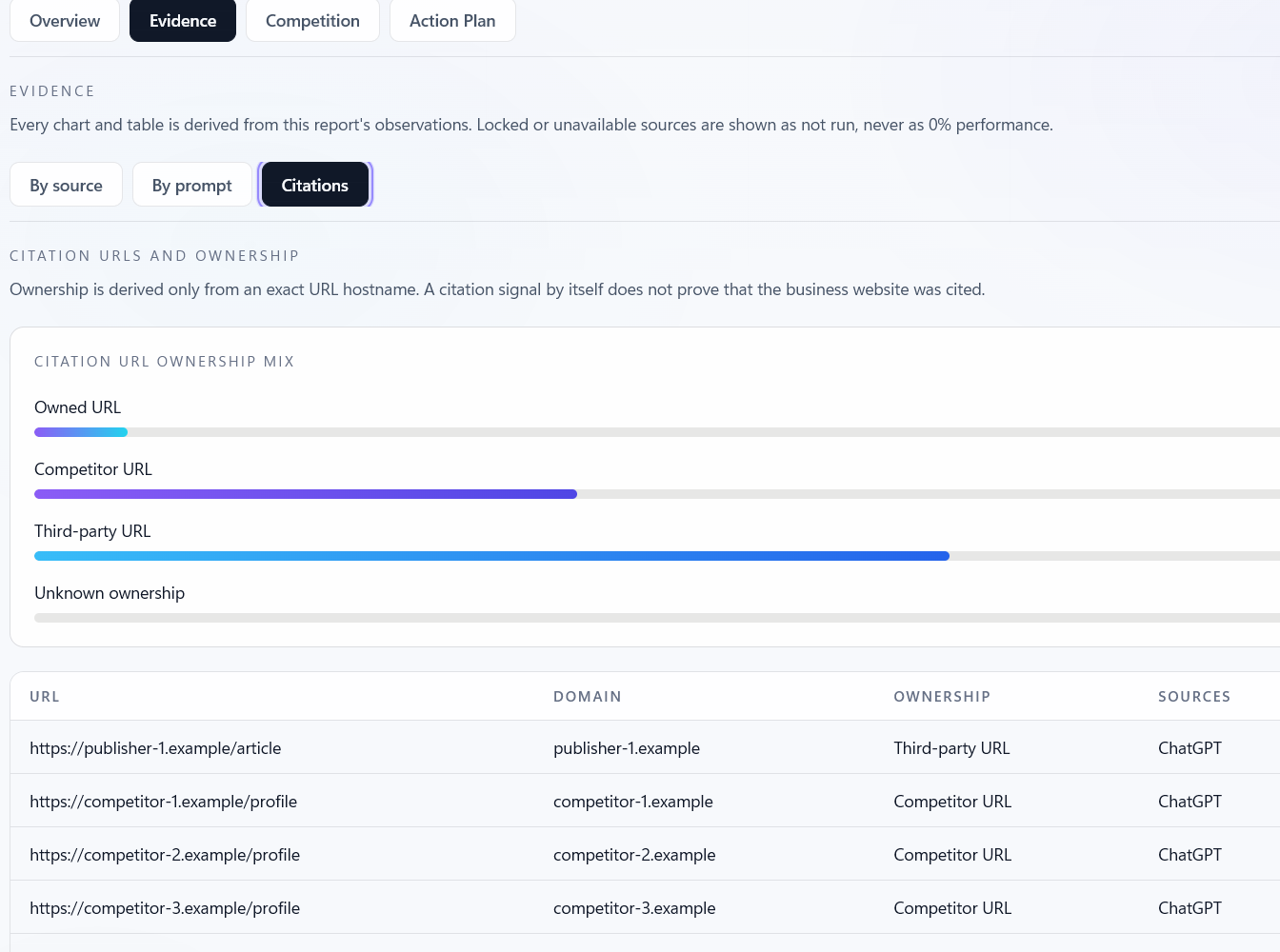
Citation ownership shows who currently supplies the evidence behind answers, not only whether a citation signal exists.
View full-size imageCitation signal is not owned citation
After a citation signal is captured, the report still determines who owns the cited URL.
See where evidence comes from
Owned, competitor, third-party, and unknown URLs remain separate instead of becoming one citation rate.
URL-level evidence stays traceable
Rows retain source and prompt counts while real domains are replaced in this public example.
The business and competitors use the same observed-answer denominator. Multiple entities can appear in one answer, so appearance rates are non-exclusive and may total more than 100%.
This makes the comparison useful without presenting it as traditional share of voice. The purpose is to show who repeatedly occupies the answer space when the business appears or is absent.
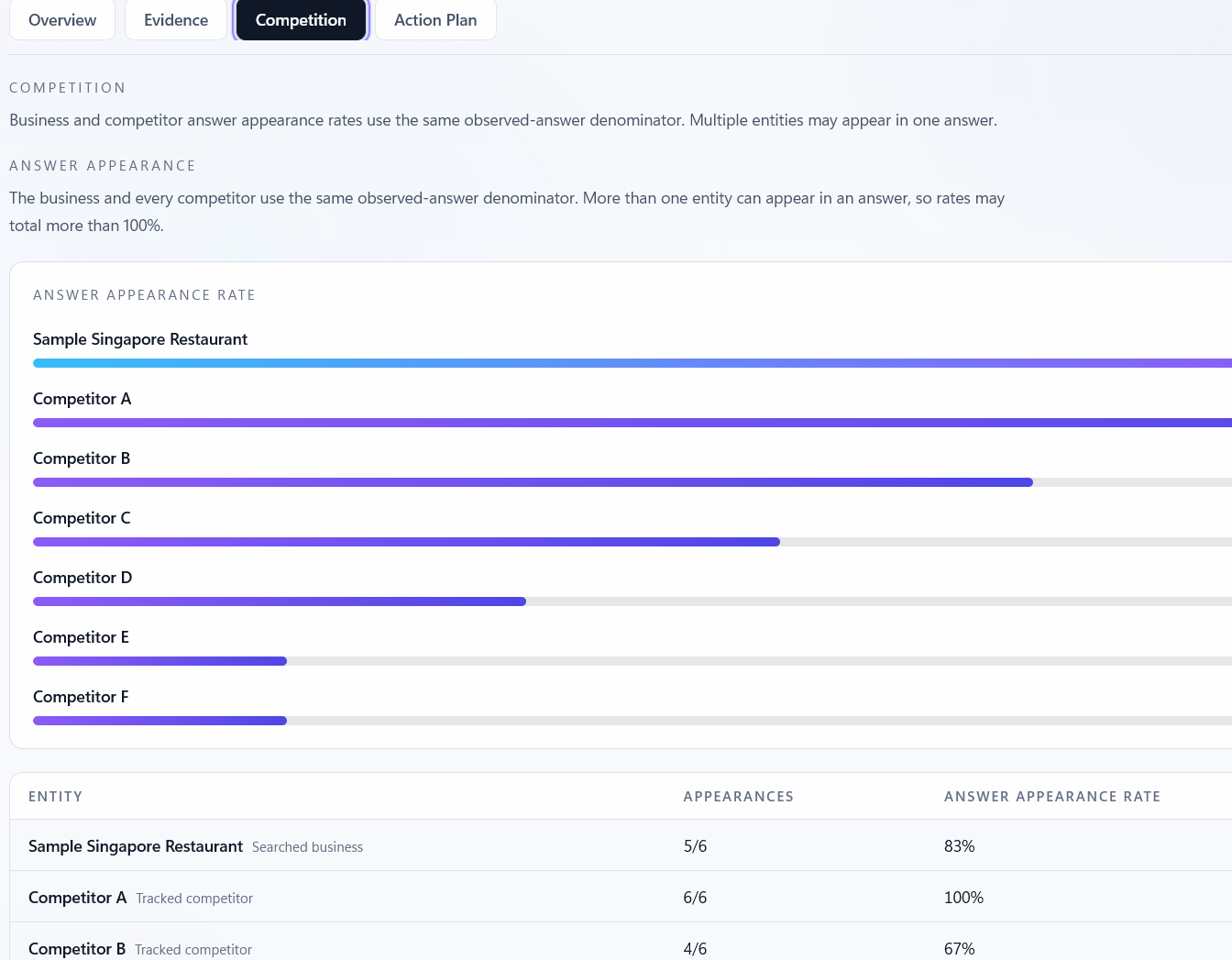
The anonymized competition view preserves real counts and denominators while removing business and competitor identities.
View full-size imageOne denominator for every entity
The business and competitors use the same observed-answer count for a fair comparison.
Appearances are non-exclusive
One answer may include several entities, so appearance rates can add up to more than 100%.
Entity roles remain explicit
The table distinguishes the searched business from tracked and observed competitors.
The Action Plan keeps one shared priority order and connects each recommendation to the affected page, the observed intent, the relevant sources, and the evidence seen in the audit.
The public example generalizes the business-specific wording and URLs, while preserving impact, effort, target location, and the ability to inspect supporting detail.
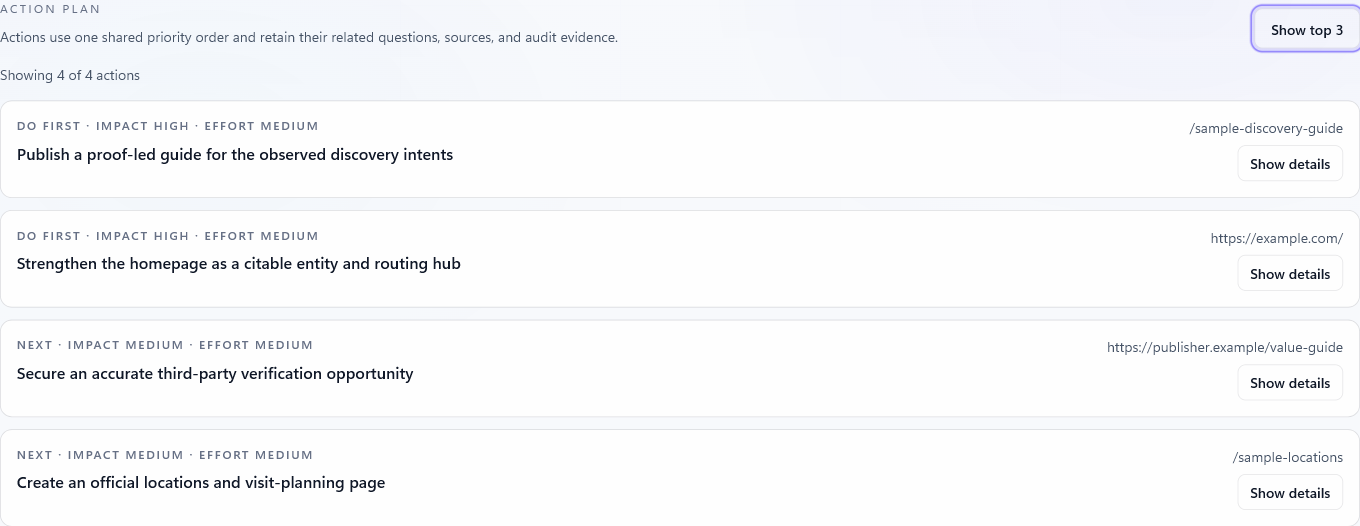
Business-specific wording and URLs are generalized, while the real prioritization and evidence-tracing structure remain.
View full-size imageOne shared priority order
Every recommendation follows the same Do first and Next sequence.
Impact and effort remain visible
The action header makes the expected value and execution cost easy to scan.
A page-level target
Each action points to the page that should be improved or created.
Supporting detail can be opened
Users can inspect the related intent, sources, and audit evidence behind a recommendation.
Full Audit shows where the brand is visible, where it is missing, who replaces it, which kinds of pages are cited, and what to fix first. The evidence is tied directly to observed AI answers rather than a generic SEO checklist.
The result is a traceable path from overview to evidence, comparison, and action.