
Tools
Health Check is a deep assessment of whether a business is organized well enough for AI systems to understand, verify, recommend, and cite it.
A normal visibility run asks whether AI mentions or recommends the business. Health Check asks whether the owned website, entity signals, pages, and public evidence give AI systems enough reliable material to understand and verify it.
The overview keeps the result readable: one readiness score, the evidence counts behind it, three diagnostic dimensions, and the most important findings. It is a current evidence-based view rather than a permanent rating.
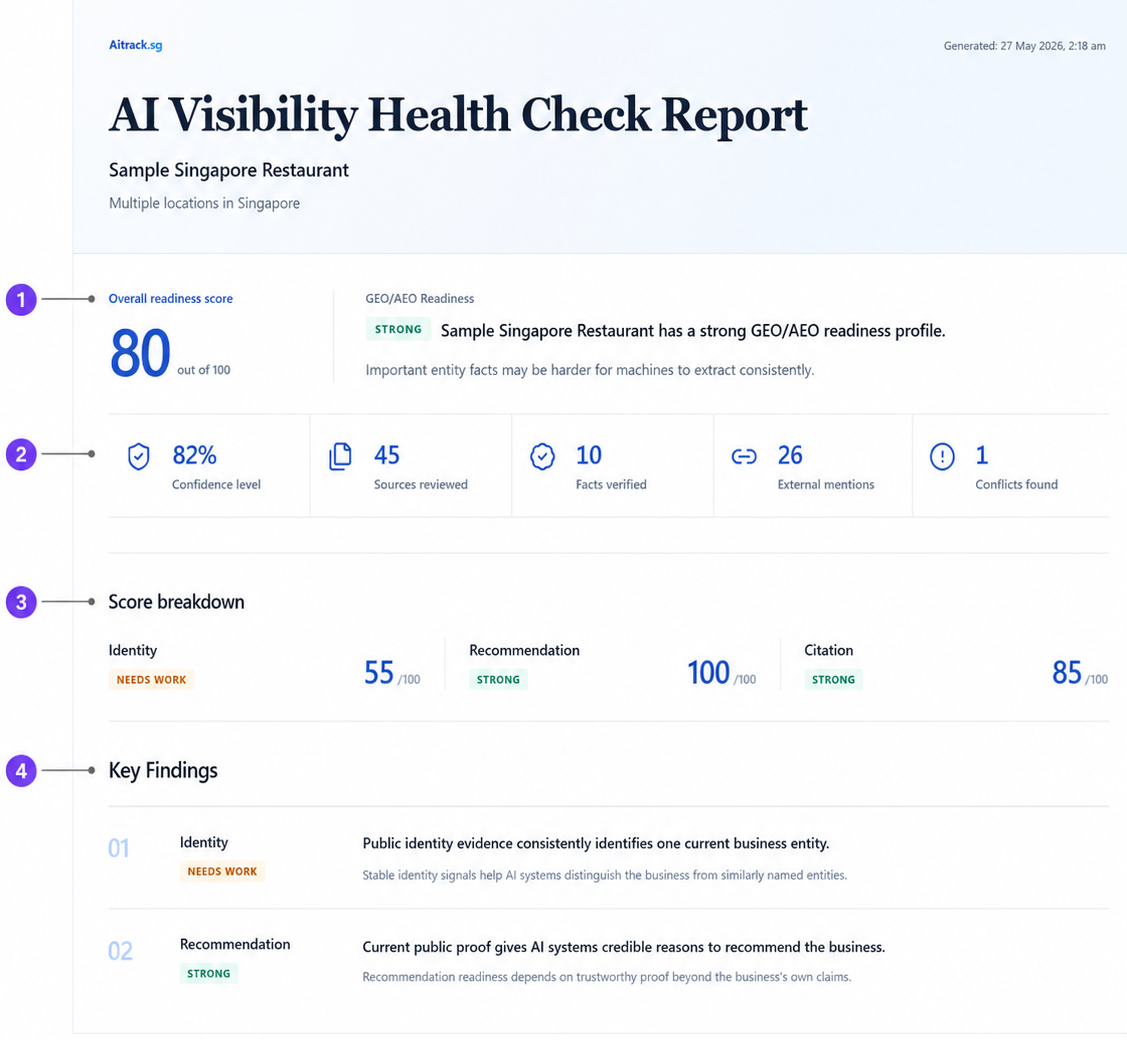
A completed, anonymized Health Check overview. Identifying details have been removed while the real report structure and evidence hierarchy remain visible.
View full-size imageOverall readiness snapshot
This is a current evidence-based readiness view, not a permanent rating.
Evidence coverage and confidence
Source counts, verified facts, external mentions, and conflicts show what supports the score.
Three readiness dimensions
Identity, recommendation, and citation are separated so the weakest area is easy to find.
Prioritized evidence findings
The report turns verified public evidence into clear areas for action.
The report pairs each important issue with a practical action rather than leaving the user with a diagnostic label. Impact, effort, and the expected result make the recommendation easier to sequence.
This public example is anonymized, but it preserves the real relationship between the evidence gap and the action the business can take next.
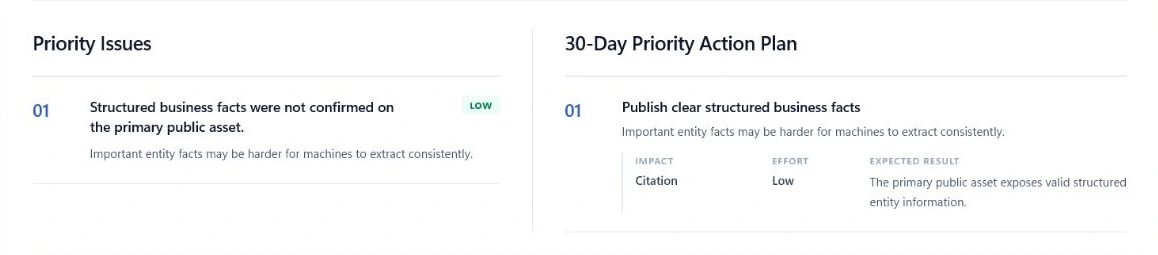
One evidence gap is connected directly to the action recommended for the next 30 days.
View full-size imageName the issue first
The Priority Issue states the evidence gap and why it affects machine understanding.
Turn diagnosis into action
The 30-day plan gives the user a practical next step rather than leaving them with a low score.
Make cost and outcome visible
Impact, effort, and expected result help the user sequence the work.
Supporting evidence separates verified facts, agreement across observed sources, conflicts, and missing evidence. The score detail then shows which readiness dimensions are strong and which need attention.
Evidence coverage identifies the kinds of public sources that contributed to the assessment. The public walkthrough keeps those categories visible while removing business-identifying source details and internal scoring mechanics.
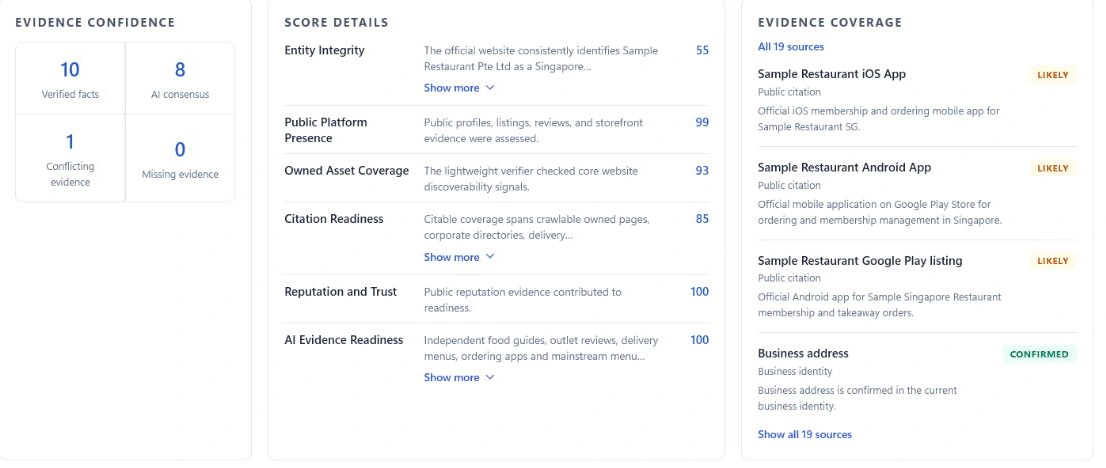
Supporting evidence explains what backs the score without publishing the internal scoring algorithm.
View full-size imageEvidence confidence inputs
Verified facts, observed agreement, conflicts, and missing evidence remain separate.
Readiness by dimension
Score details reveal strong and weak areas instead of reducing the assessment to one number.
Coverage and evidence status
Evidence rows retain statuses such as Likely and Confirmed while business identities are removed.
A conflict is a concrete inconsistency in public evidence, not simply a low score. Health Check groups those inconsistencies separately and explains what should be verified before the next run.
The recheck guidance helps users avoid rerunning too early. It points to the conditions that should change first, such as clearer structured data, consistent outlet information, or a retrievable local profile.
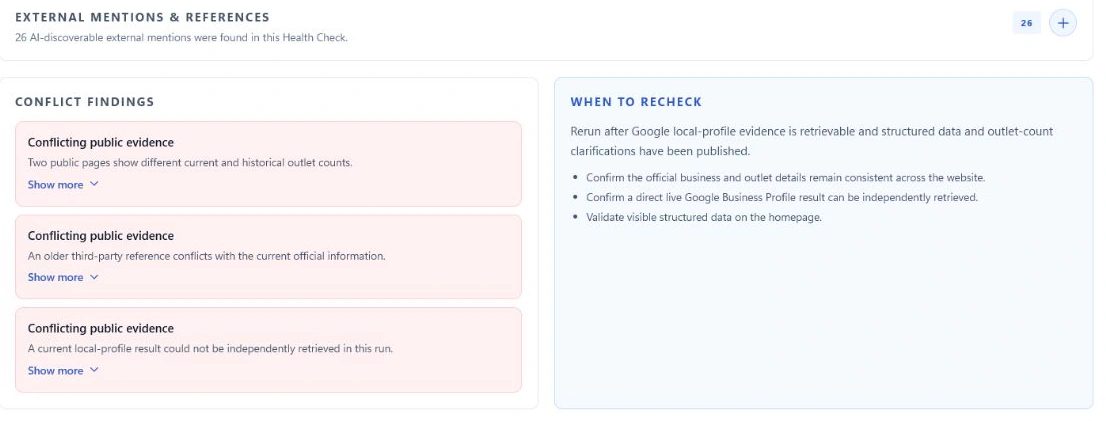
Brand and negative-event details are removed; the visual preserves only the conflict and recheck workflow.
View full-size imageExternal evidence has its own count
External mentions show discoverable public references and are not the same as recommendations.
Conflicts must be concrete
Conflict Findings describes explainable public inconsistencies rather than relabelling missing evidence.
Change the evidence before rerunning
When to recheck tells the user which conditions should improve before another Health Check.
The final report converts evidence into priorities: which page to improve, what proof to add, and why the change may help AI systems recommend or cite the business more reliably.
The recommendations stay evidence-grounded rather than relying on generic templates, covering readiness diagnosis, owned asset coverage, conflict findings, priority actions, and a sensible point to recheck.